Yellowstone Bison
~5,000 in two herds — Hayden & Lamar valleys.
Overview
American bison (Bison bison) are grazers — grasses and sedges make up most of their diet. Yellowstone's herd splits into a northern herd (Lamar Valley) and a central herd (Hayden Valley/Mary Mountain); they intermix in some winters but calve and rut separately.
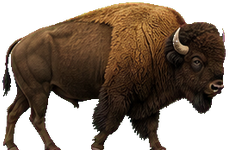
Bison are the park's signature animal and also its most dangerous to visitors — they injure more people than any other species because they look slow but can run 35 mph and weigh up to a ton.
Where to find them
- Hayden Valley: Often the largest single herds in the park.
- Lamar Valley: Northern herd; easy roadside viewing.
- Madison & Firehole: Winter herds in the geyser basins.
- Anywhere green in summer: Bison cause 'jams' across the park.
When to look
Year-round. Calves ('red dogs') appear late April–May; the rut runs July–August (dramatic bellowing and sparring); winter herds gather in thermal valleys.
⚠️Stay at least 25 yd away
Frequently asked questions
How many bison are in Yellowstone?+
Roughly 5,000 in two herds at the summer peak — the largest free-roaming population on U.S. public land. Numbers fluctuate with the breeding cycle and a cooperative management program.
When are bison calves born?+
Late April through May. The orange-red calves ('red dogs') stand out against the herd and are a spring highlight. They darken to brown by late summer.
When is the bison rut?+
Late July through August. Bulls compete for cows, wallow in dust, and bellow dramatically. Prime viewing, but also when bison are most aggressive — keep distance.
Why are bison managed?+
Bison can carry brucellosis, which threatens cattle outside the park. NPS, the state of Montana, and tribes coordinate a management program including capture, transfer to tribes, and limited hunting outside park boundaries — keeping the herd healthy while addressing the disease concern.
Sources & data notes
- Bison data is drawn from official NPS, USGS, and NOAA sources catalogued in our source registry. Observer-submitted sightings are not published on this public guide.
- Bison carries dedicated official data (NPS ecology / management reports).
- NPS Yellowstone bison ecology — National Park Service (Current official bison population/context page; not a granular survey dataset.)
- NPS Yellowstone bison management — National Park Service (Official bison management goals and policy context; not individual observations.)
- Dryad bison population surveys in Yellowstone National Park 1970-1997 — Dryad / USGS / Montana State University (Historical aerial survey CSV metadata is public; direct file download may require browser/session access.)
Spotted something off, or want a deeper dive? Every claim above links to its original source — look for the ↗ markers and the Sources section.