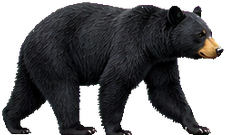
Yellowstone Black Bear
Forest edges and Tower-Roosevelt — smaller, more arboreal.
Overview
American black bears (Ursus americanus) are smaller and more forest-oriented than grizzlies. They're accomplished climbers (grizzlies are not), favor forest edges, and emerge from dens a little after grizzlies in spring.
Black bears are common in the park — the NPS 2018 bear management report recorded 665 black bear sightings — and are most often seen in the Tower-Roosevelt area and along the northern-range forest edge.
Where to find them
- Tower-Roosevelt: The classic black bear area — forest edges and meadows.
- Northern range forest edge: Black bears prefer cover; scan the treeline, not the open valley.
- Mammoth area: Occasional sightings in the developed zone.
When to look
Spring (May–June) after emergence, and fall during hyperphagia. Dawn and dusk along forest edges. They retreat to dens by November.
⚠️Stay at least 100 yd away
Frequently asked questions
Are all black bears black?+
No — color is unreliable. Yellowstone black bears range from black to brown, cinnamon, and even blonde. Identify by shape (no shoulder hump, straight face, pointed ears), not color.
Where is the best place to see a black bear?+
The Tower-Roosevelt area and northern-range forest edges. Unlike grizzlies, black bears favor cover — look at the treeline rather than in open meadows. Dawn and dusk are best.
Do black bears climb trees?+
Yes — they're excellent climbers (grizzlies generally are not). A black bear will send cubs up a tree when threatened. Never approach a tree with a black bear cub in it.
Are black bears dangerous?+
Yes, especially sows with cubs. Give them 100 yards, carry bear spray, and never corner one. Black bear attacks are rare but can be serious; treat them with the same respect as grizzlies.
Sources & data notes
- Black Bear data is drawn from official NPS, USGS, and NOAA sources catalogued in our source registry. Observer-submitted sightings are not published on this public guide.
- Black Bear carries dedicated official data (NPS ecology / management reports).
- NPS Yellowstone bear management page — National Park Service (Official bear-management process and BMA context; annual reports still need deeper PDF parsing.)
- NPS Yellowstone Bear Management annual reports — National Park Service (Only a small subset of available annual bear reports is currently parsed.)
- NPS Yellowstone mammals overview — National Park Service (Official mammal checklist/context page with current park-level population notes; not point data.)
Spotted something off, or want a deeper dive? Every claim above links to its original source — look for the ↗ markers and the Sources section.